

Board Performance · 2025
In this section14 topics
- Compliance Monitoring — Overview1 item
- Prevention of Conflicts of Interest3 items
- Prevention of the Use of Inside Information3 items
- Anti-Corruption4 items
- Whistleblowing3 items
- Selection of Directors & Chief Executives6 items
- Selection of Independent Directors2 items
- Director Development1 item
- Evaluation of Board & Subcommittee Performance2 items
- Subcommittees1 item
- Meeting Attendance & Remuneration2 items
- Supervision of Subsidiaries & Associated Companies4 items
- Audit Committee Duty Performance1 item
- Executive Committee Duty Performance1 item
Compliance Monitoring — Overview
Compliance Monitoring — Introduction
The Company places great importance on good corporate governance. It has established relevant policies and guidelines under its Corporate Governance Principles and Code of Conduct and actively promotes their effective implementation to strengthen confidence among all stakeholder groups.
In 2025, the Company monitored compliance with its corporate governance principles as follows:
Prevention of Conflicts of Interest
Has the Company Acted to Prevent Conflicts of Interest?
Yes
Operations in the Past Year
The Board of Directors, together with the Audit Committee, carefully oversees any transactions that may involve conflicts of interest to ensure their reasonableness and necessity. The Board also ensures that information relating to such transactions is appropriately disclosed to stakeholders and relevant regulatory authorities following the resolution approving the transaction.
In 2025, the Company’s directors and executives disclosed their interests and those of their related people to the Company through the Company Secretary. Such information was compiled and submitted to the Audit Committee and the Board of Directors for consideration of transactions that may involve conflicts of interest. Directors and executives who had an interest in the relevant transaction were not entitled to attend the meeting or vote on such matters.
The Company has continuously communicated and enhanced awareness among directors, executives, and employees of the Company and its subsidiaries through training programs, knowledge refreshers, and meetings conducted in 2025, both online and on-site. The training covered the Code of Conduct, anti-corruption policies, securities trading policies for directors and executives, prevention of insider trading, and conflict of interest prevention. Directors of the Company and its subsidiaries, executives, target employees, and newly hired employees completed the required orientation and training programs, achieving a 100 percent completion rate across all groups. In addition, good governance practices were regularly communicated through internal communication channels, including TMT Magazine, Touch Point, Line@TMT, e-mail, and TMT SharePoint, to promote awareness of good corporate governance.
A total of 649 directors, executives, and employees at all levels participated in these activities, representing 47.27 percent of the total workforce of the Company and its subsidiaries.
No violations of the Company’s conflict of interest policy were identified. Details are disclosed under the section “Related Party Transactions.”No actions violating the conflict-of-interest policy were found. Details are presented in
the report titled "9.2 Related Party Transactions."
Number of Conflict-of-Interest Cases
| Metric | Current Year | Previous Year | Two Years Ago |
|---|---|---|---|
| Total number of cases or issues related to conflicts of interest (cases) | 0 | 0 | 0 |
Prevention of the Use of Inside Information
Has the Company Acted to Prevent the Use of Inside Information?
Yes
Operations in the Past Year
The Board of Directors has established a securities trading policy for directors, executives, and employees, requiring all directors, executives, and designated persons of the Company to comply with the prohibition on insider trading as stipulated by the Securities and Exchange Act. In addition to directors and executives who are required by law to report their securities holdings and changes in securities holdings to the Securities and Exchange Commission ("SEC"), the Company also requires directors, executives, and designated persons (individuals who are related to and aware of or possess inside information) to sign an acknowledgment of their duty to report their own securities holdings and changes in securities holdings, including those of their spouses and minor children, to the Company secretary within the specified timeframe from the date of purchase, sale, transfer, or receipt of transfer of securities or derivative contracts. Furthermore, the Company has established a "Blackout Period" prohibiting directors, executives, and designated persons from trading the Company's securities during the following periods:
1. 30 days prior to the disclosure of quarterly and annual financial statements, and 1 business day after the
disclosure of quarterly and annual financial statements to the Stock Exchange of Thailand.
2. 14 days prior to the disclosure of the Board of Directors' resolution approving significant events affecting the price
or value of securities, and 1 business day after such resolution has been disclosed by the Board to the Stock
Exchange of Thailand. The Company has also established a "Quiet Period" of 14 days prior to the disclosure of
quarterly and annual financial statements, as well as Board of Directors' resolutions approving significant events
affecting the price or value of securities to the Stock Exchange of Thailand. Should any director, executive, or
employee of the Company use the Company's inside information for personal gain, and such action causes
damage to the Company, the Company will consider disciplinary action, potentially leading to termination of
employment, and may also face both criminal and civil liability under the Securities and Exchange Act B.E. 2535
(1992) and/or relevant announcements by government agencies. In 2025, the Company has taken the following
actions:
Notify directors, executives, and designated persons of the Company about the Blackout Period via
company email 30 days prior to the disclosure of quarterly and annual financial statements, and 1 business day
after the disclosure.
Prepare quarterly reports on securities holdings of directors, executives, and individuals related to and aware
of or possessing inside information and submit them to the Company secretary.
Continuously communicate and enhance knowledge and understanding among directors, executives, and
employees of the Company and its subsidiaries by organizing training, knowledge reviews, and annual meetings
in 2025, both online and on-site, on courses related to business ethics, anti-corruption, securities trading policy,
prevention of insider trading, and prevention of conflicts of interest. Directors of the Company and its
subsidiaries, executives, target employee groups, and new employees have completed orientation training,
accounting for 100 percent in all groups. Additionally, best practices are regularly communicated through
internal communication channels such as TMT Magazine, Touch Point, Line@TMT, E-mail, and TMT SharePoint
to raise awareness of good corporate governance. A total of 649 directors, executives, and employees at all
levels participated in these activities, representing 47.27 percent of all employees of the Company and
its subsidiaries.
In 2025, no directors, executives, or employees were found to have accessed inside information and violated the securities trading policy for directors, executives, and employees of the Company.
For the year 2025, directors and executives had the following changes in securities holdings:
Name - Surname | Position | Number of shares held | Number of shares Change | |
31/12/2024 | 31/12/2025 | Increase (Decrease) | ||
Mr. Chai Jroongtanapibarn | Chairman of the Board / Chairman of the Audit Committee / Nomination and Remuneration Committee / Independent Director | 1,045,500 | 1,045,500 | - No change - |
Mr. Anake Pinvanichkul | Chairman of Nomination and Remuneration Committee / Chairman of a Risk Management and Strategy Development Committee / Audit Committee / Independent Director | 544,000 | 544,000 | - No change - |
Mrs. Ratanavalee Gorsanan | Chairman of the Corporate Governance and Sustainability Committee / Audit Committee/ Nomination and Remuneration Committee / Independent Director | 634,000 | 634,000 | - No change - |
Mr. Paisal Tarasansombat | Director / Corporate Governance and Sustainability Committee / Chief of Executive Director / Chief Executive Officer | 169,267,700 | 169,267,700 | - No change - |
Mr. Somjate Tretarnthip | Director / Nomination and Remuneration Committee / Risk Management and Strategy Development Committee / Executive Director / Chief Finance Officer / Company Secretary | 4,000,000 | 4,000,000 | - No change - |
Mr. Komsan Tarasansombat | Director / Risk Management and Strategy Development Committee / Corporate Governance and Sustainability Committee / Executive Director / Chief Operations Officer | 128,540,150 | 128,540,150 | - No change - |
Mr. Prawas Sontawakul | Director / Risk Management and Strategy Development Committee / Executive Director | 500,000 | 500,000 | - No change - |
Mrs. Panlapa Tarasansombat | Corporate Governance and Sustainability Committee/ Executive Vice President – Human Resources | 36,621,000 | 36,621,000 | - No change - |
Mr. Somsak Tomorakul | Executive Vice President – Marketing | 2,298,362 | 2,701,562 | 403,200 |
Number of Inside-Information Cases
| Metric | Current Year | Previous Year | Two Years Ago |
|---|---|---|---|
| Total number of cases or issues related to the use of inside information to seek benefits (cases) | 0 | 0 | 0 |
Anti-Corruption
Has the Company Acted on Anti-Corruption?
Yes
Operations in the Past Year
The Company prioritizes anti-corruption and bribery, as well as promoting awareness among personnel at all levels to combat all forms of corruption and bribery. Therefore, the Board of Directors has established a policy for the prevention and suppression of corruption, including the giving or receiving of bribes, within the Company's Anti-Corruption policy and operational guidelines, to ensure that executives and employees at all levels adhere to the prescribed guidelines.
This includes conducting corruption risk assessments within the organization to align with the anti-corruption policy. Monitoring, prevention, and management are implemented to reduce the likelihood of illegal acts. Systematic tracking, inspection, and control are also in place, with results reported to the Board of Directors through the Corporate Governance and Sustainability Committee at least once a year or when new risks emerge. The Corporate Corruption Risk Management Handbook is published on the Company's website at [www.tmtsteel.co.th/corporate governance/principles of good corporate governance/anti-corruption/corruption risk management manual].
In 2025, the Company demonstrated its commitment to anti-corruption efforts and reported the performance of its anti-corruption measures to the Board of Directors through the Corporate Governance and Sustainability Committee at its 2/2025 meeting, with details as follows:
Communicated the Business Code of Conduct to business partners, contractors, and subcontractors, with partners signing acknowledgments. Additionally, business partners and associates were invited to join the Thai Private Sector Collective Action Against Corruption (CAC). Currently, one entity, Sahaviriya Steel Industries Public Company Limited, has been certified as a member of the Thai Private Sector Collective Action Against Corruption (CAC) from December 31, 2023, to December 31, 2026.
Announced the No Gift Policy for 2025 and communicated it to external parties, customers, business partners, and those involved in the Company's business operations through both internal and external communication channels. Details are published on the website at [www.tmtsteel.co.th/corporate governance/principles of good corporate governance/anti-corruption/no gift policy].
Communicated channels for whistleblowing or complaints through the "Call for... We Report" project, organized by the Thai Private Sector Collective Action Against Corruption (Coalition Against Corruption: CAC) in collaboration with the National Anti-Corruption Commission (NACC), to serve as a channel for reporting tips, complaints, or behaviors that may constitute corruption, soliciting benefits, or non-transparent actions.
Continuously communicated and enhanced knowledge and understanding for directors, executives, and employees of the Company and its subsidiaries by organizing training, knowledge reviews, and annual meetings in 2025, both online and on-site. These courses covered business ethics, anti-corruption, securities trading policies, prevention of insider trading, and prevention of conflicts of interest. Directors of the Company and its subsidiaries, executives, target employee groups, and new employees completed their orientation training, achieving 100 percent completion in all groups. Additionally, best practices were regularly communicated through internal communication channels, including TMT Magazine, Touch Point, Line@TMT, E-mail, and TMT SharePoint, to raise awareness of good corporate governance. A total of 649 directors, executives, and employees at all levels participated in these activities, representing 47.27 percent of the total employees of the Company and its subsidiaries.
Maintained membership status with the Thai Private Sector Collective Action Against Corruption (CAC) from December 31, 2023, to December 31, 2026. For more details, visit [www.thai-cac.com/who-we-are/our-members].
Form of Anti-Corruption Operations
| Operation |
|---|
| Review of appropriateness in anti-corruption |
| Assessment and identification of corruption risk |
| The participation in anti-corruption projects |
| Communication and training for employees on anti-corruption policy and guidelines |
| The monitoring of the evaluation of compliance with the anti- corruption policy |
| Review of the completeness and adequacy of the process by the Audit Committee or auditor |
Number of Corruption Cases
| Metric | Current Year | Previous Year | Two Years Ago |
|---|---|---|---|
| Total number of cases or issues related to corruption (cases) | 0 | 0 | 0 |
Whistleblowing
Has the Company Implemented Whistleblowing Procedures?
Yes
Operations in the Past Year
The Company has established a monitoring system to receive information on internal irregularities to prevent, monitor, and detect potential anomalies arising from internal operations (Whistleblowing Process), which may pose
risks leading to damage to assets, reputation, and personnel, various complaints, illegal acts, or indications of corruption.
Therefore, the Company has provided channels for all stakeholders to report internal irregularities or complaints related to operations, violations of company regulations, business ethics, and corruption. Whistleblowers or complainants can submit documents and supporting evidence through various channels as follows:
Channels for complaints, both disclosed and anonymous.
Deputy Managing Director, Human Resources Department
e-mail: panlapa@tmtsteel.co.th
Communication and Whistleblowing Committee
e-mail: sd@tmtsteel.co.th
Audit Committee: Ms. Rattanawalee Kosanan
e-mail: ind_dir@tmtsteel.co.th
Company Secretary: Mr. Somjate Treetharathip
e-mail: somjate@tmtsteel.co.th
The Company provides fairness and protection to employees or any other individuals who report clues or evidence of misconduct, by implementing measures to protect complainants or those who cooperate in reporting corruption as specified. The Company has disclosed the process, protection measures for whistleblowers or complainants, and complaint channels on its website at [www.tmtsteel.co.th/corporate governance/whistleblowing].
In 2025, there were no whistleblowing reports or complaints regarding the Company's operations, violations of regulations, business ethics, or corruption, nor were any perpetrators found in these matters.
Number of Whistleblowing Cases
| Metric | Current Year | Previous Year | Two Years Ago |
|---|---|---|---|
| Total number of cases or issues received through whistleblowing channels (cases) | 0 | 0 | 0 |
Selection of Directors & Chief Executives
Selection — Introduction
Criteria and Process for Director Nomination and Appointment
1. Criteria for the Nomination and Appointment of New Directors are based on the following criteria:
Compliance with applicable laws, relevant regulations, and the Company's Articles of Association.
Possession of qualifications, skill, knowledge, abilities, and experience in various professional fields,
as well as specialized expertise (Board Skill Matrix) that is beneficial for performing duties.
Consideration of potential conflicts of interest with the Company.
Other necessary qualifications consistent with the Company's business strategy and duties.
Demonstration of integrity and ethical conduct in performing duties.
2. The selection and appointment of directors (existing directors proposed for re-election or adjustment of
senior executive positions) are based on the following criteria:
Past performance and contribution to the Company.
Constructive opinions and recommendations provided to the Company.
Dedication of time and capabilities toward the Company’s development.
Attendance at Board meetings and participation in Company activities.
Demonstration of integrity and ethical conduct in performing duties.
Relevant knowledge, abilities, and experience in various professional fields in accordance
with the Board Skill Matrix.
Nomination and Appointment Process
1. The Nomination and Remuneration Committee considers, selects, and nominates suitable individuals based on the
established criteria, together with other qualifications aligned with the Company’s business strategy, to replace
directors or senior executives whose terms have expired, whose positions are vacant, or newly established in
accordance with resolutions of the Board of Directors or applicable laws.
2. The Committee verifies that nominated individuals meet the qualifications required under relevant laws and
regulations. It approaches individuals who meet the established criteria to ensure their willingness to accept
the position if appointed by the Board of Directors and/or the shareholders. The list of the most suitable
candidates, together with their profiles and supporting documents, is then submitted to the Board of Directors
and/or the Shareholders’ Meeting for consideration and approval.
In 2025, the Company granted shareholders the right to nominate suitable individuals for election as directors of the Company during the period from January 13, 2025, to February 14, 2025, and published the announcement on its website at [www.tmtsteel.co.th/investor relations/shareholder information/annual general meeting/2025].
However, no shareholder submitted any nomination in advance for election as a director.
Directors & Chief Executives — Introduction
1. The nomination and appointment of the Chief Executive Officer and senior executives are based on
the following criteria:
Compliance with applicable laws, relevant regulations, and the Company’s Articles of Association.
Possession of qualifications, skills, knowledge, and professional experience in various fields, including
specialized expertise in accordance with the Board Skill Matrix, that are beneficial to the performance of duties.
Consideration of any potential conflicts of interest with the Company.
Other qualifications are deemed necessary and aligned with the Company’s business strategy and
responsibilities.
Demonstration of integrity and ethical conduct in performing duties.
2. The nomination and appointment of the Chief Executive Officer and Senior Executives (existing individuals for
re-appointment or position adjustment of Senior Executives) are considered based on the following criteria:
Past performance and contributions to the Company.
Constructive opinions and recommendations provided for the benefit of the Company.
Dedication of time and capabilities toward the Company’s development.
Attendance at meetings and participation in Company activities.
Demonstration of integrity and ethical conduct in performing duties.
Relevant knowledge, skills, and experience in accordance with the Board Skill Matrix. Method for selecting
Are Directors Selected Through the Nomination Committee?
Yes
Are Chief Executives Selected Through the Nomination Committee?
Yes
Rights of Minority Shareholders on Director Appointment
The appointment of the Company's Board of Directors is in accordance with the Company's Articles of Association. That is, the Annual General Meeting of Shareholders elects the directors according to the following criteria and methods:
1 Each shareholder is entitled to one vote per share held.
2. Each shareholder must cast all votes available under Clause 1.1 to elect one or more persons as directors
and may not allocate votes among candidates in varying proportions.
3. The persons receiving the highest number of votes in descending order shall be elected as directors, equal to
the number of directors to be appointed or elected at that meeting.
In the event that candidates receiving the next highest votes obtain an equal number of votes exceeding the number of directors to be appointed, the Chairman of the meeting shall cast the deciding vote. Furthermore, one or more shareholders combined, holding shares amounting to not less than 5 percent of the paid-up registered capital, may exercise the right to nominate persons for consideration for election as directors in advance, according to the date, time, and conditions announced by the Company through the notification channels of the Stock Exchange of Thailand and the Company's website.
In 2025, no shareholder submitted any nomination in advance for election as a director. At the Annual General Meeting of Shareholders 2025
The meeting considered the election of directors individually, whereby directors with a conflict of interest were not entitled to vote.
Method of Director Appointment
| Method |
|---|
| Method whereby each director requires approval votes more than half of the votes of attending shareholders with voting rights |
Selection of Independent Directors
Criteria for Selecting Independent Directors
Compliance with applicable laws, relevant regulations, and the Company’s Articles of Association.
Possession of qualifications, skills, knowledge, and professional experience in various fields, including specialized
expertise in accordance with the Board Skill Matrix, that are beneficial to the performance of duties.
Consideration of any potential conflicts of interest with the Company.
Other qualifications are deemed necessary and aligned with the Company’s business strategy and
responsibilities.
Demonstration of integrity and ethical conduct in performing duties.
The number of independent directors on the Board must comply with the requirements of the Office of the Securities and Exchange Commission (SEC), and such directors must meet the definition of an independent director as prescribed in the notification of the Capital Market Supervisory Board regarding the application for and
approval of newly issued shares (No. 2), or as may be amended or prescribed by applicable law in the future.
Did Any Independent Director Have a Business or Professional Relationship?
No
Director Development
Development of Directors in the Past Year
The Company has established a Board Skill Matrix to serve as a framework for developing the knowledge, expertise, and specific competencies required of its Board of Directors. The matrix is designed based on appropriate and diverse qualifications, including educational background, professional experience, relevant business expertise, and specialized skills necessary for the Company’s operations. The Company has identified 11 key competency areas deemed essential for the Board of Directors, as follows:
Board Skill Matrix
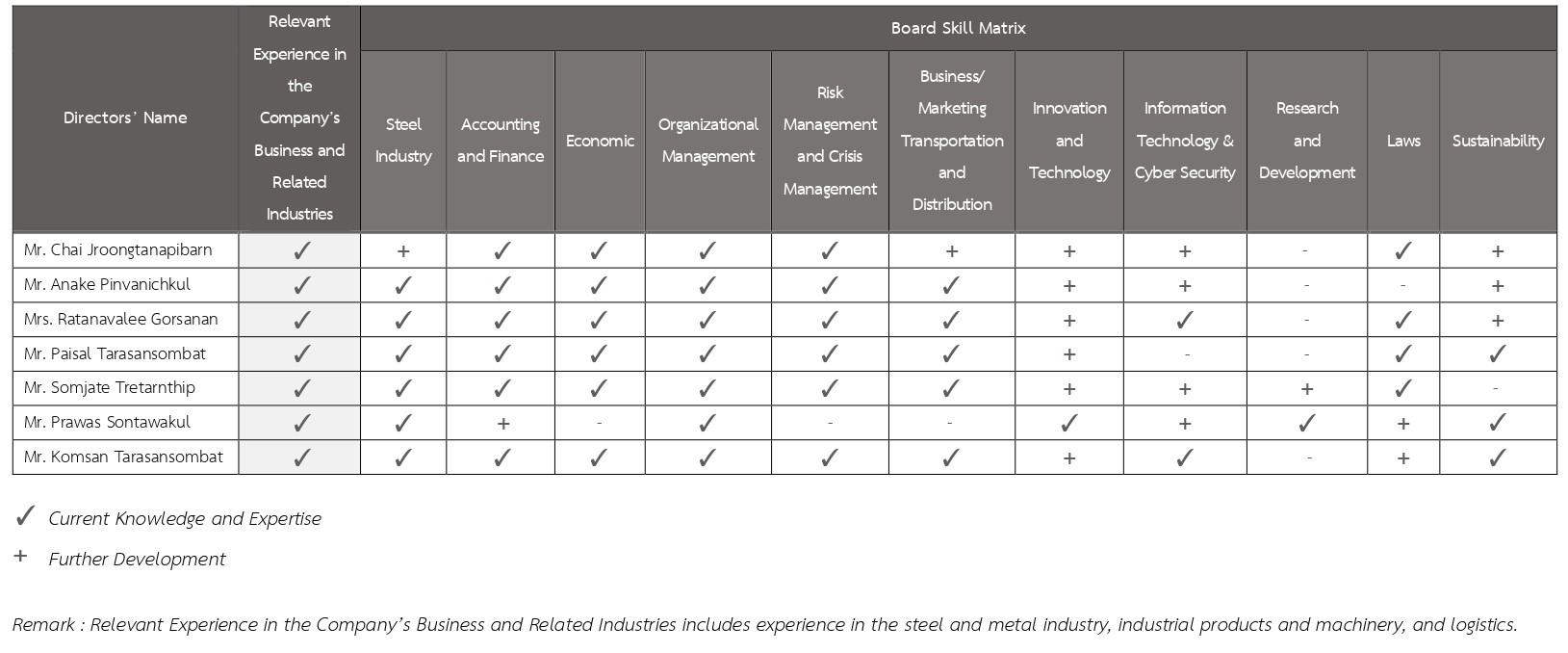
In 2025, the Board of Directors reviewed and revised the Board Skill Matrix, comprising 11 specific areas. All directors conducted a self-assessment to identify areas for further development. Based on the results of this review, the Company will consider appropriate training courses and development programs for the Board of Directors in 2026.
Orientation
In the event of new appointments of directors or executives who have not previously held positions as directors or senior executives of the Company, such individuals will receive an orientation conducted by senior management or the Company Secretary. The orientation covers important rules, regulations, and the Company’s Articles of Association, as well as information regarding the Company’s business nature and policies, corporate governance policies, business ethics, and other relevant corporate matters.
Development and Training of Directors and Executives
The Company encourages and supports directors, senior executives, and the Company secretary to attend relevant training courses to enhance their knowledge and capabilities. Adequate budget has been allocated to support continuous development and to enable the Company to benefit from the knowledge and experience gained. In 2025, directors and executives received training from various institutions, as well as internal programs arranged by the Company, based on the results of the annual training needs assessment, as summarized below:
Evaluation of Board & Subcommittee Performance
Criteria for Evaluating Board Performance
The Board of Directors has established an annual performance evaluation for the Board as a whole, individual directors, all sub-committees, and the Chief Executive Officer (CEO). The evaluation is conducted at least once a year to enable the Board to collectively review past performance and utilize the evaluation results for continuous development and improvement, thereby enhancing the effectiveness of the Board’s operations and promoting the highest standards of corporate governance. In 2025, the details of the performance evaluations of the Board of Directors, sub-committees, and the Chief Executive Officer (CEO) are summarized as follows:
Evaluation of Board Performance in the Past Year
Board of Directors and sub-committees self-evaluated their performance, with 3 main evaluation topics: 1. Structure and qualifications of the Board of Directors and sub-committees 2. Meetings of the Board of Directors and committees sub-committees 3. Roles, duties, and responsibilities of the Board of Directors and sub-committees, with evaluation results detailed as follows:
The self-evaluation results of the Board of Directors, both as a whole and on an individual basis, were
completed by 7 directors, with an average score of 100.00 percent.
The self-evaluation results of the Audit Committee, both as a whole and on an individual basis, were
completed by 3 committee members, with an average score of 99.72 percent.
The self-evaluation results of the Nomination and Remuneration Committee, both as a whole and on
an individual basis, were completed by 4 committee members, with an average score of 98.92 percent.
The performance evaluation results of the Risk Management and Organizational Strategy Committee, both
as a whole and on an individual basis, were completed by 4 committee members, with an average score
of 99.00 percent.
The performance evaluation results of the Corporate Governance and Sustainability Committee, both
as a whole and on an individual basis, were completed by 4 committee members, with an average score
of 99.25 percent.
Subcommittees
Subcommittees
| Results of the Subcommittee's Duty Performance |
|---|
The Nomination and Remuneration Committee was appointed by the Board of Directors. The term of office is 3 years. The Nomination and Remuneration Committee comprises 3 Independent Directors and 1 Director, with an Independent Director serving as the Chairman. The Board of Directors assigned the Nomination and Remuneration Committee to be responsible for considering policies, criteria, and methods for the recruitment, appointment, assignment, allocation, nomination, and monetary or non-monetary remuneration for the Board of Directors, subcommittees, and the Chief Executive Officer. The Committee is also responsible for reviewing the qualification requirements and the performance evaluation criteria as well as surveying the needs for skill and knowledge development of the Company directors, subcommittees, and the Chief Executive Officer. In 2025, the Nomination and Remuneration Committee held a total of three meetings and performed its duties in accordance with its charter, which may be summarized as follows:
All 4 members of the Nomination and Remuneration Committee fully attended the 3 meetings. The results of the meetings and the performance were reported to the Board of Directors for acknowledgment |
The Risk Management and Corporate Strategy Development Committee comprise of 1 Independent Director, 3 Directors, and 1 Vice President serving as the Committee Secretary. The term of office is 3 years, with an Independent Director serving as the Chairman of the Committee. The Committee is responsible for supervising, monitoring, reviewing, evaluating, and supporting the Company in establishing effective risk management and management systems to appropriately control risks and promote corporate strategy development, in order to enhance value-creating business operations and deliver benefits to stakeholders toward sustainable growth. In 2025, the Committee held a total of two meetings. The key matters arising from the performance of its duties are summarized as follows: 1. Oversight of Risk Management The Risk Management and Strategy Development Committee reviewed and considered Company’s risk management policy and the Enterprise Risk Management Manual for the year 2025 to ensure consistency with current operations and to serve as an operational guideline for defining practices, communication, and the development of efficient work processes under appropriately controlled risks. This covers risk management principles, strategies, frameworks, as well as organizational structures, roles, duties, and responsibilities of relevant parties, including the risk management process developed in accordance with the Committee of Sponsoring Organizations of the Treadway Commission (COSO) (2017 Enterprise Risk Management – Integrated Framework) and the EY Enterprise Risk Management Framework. Accordingly, the Company categorized enterprise risks into six categories as follows: 1. Strategic Risk 2. Operational Risk 3. Financial Risk 4. Compliance Risk 5. Environmental, Social Governance: ESG Risks 6. Emerging Risks 2. Consider and Monitor Enterprise Risk Management The Committee monitored the implementation and performance of enterprise risk management across all six business risk categories based on reports from management and the risk management working group. Such report included assessment of risk factors that may affect the Company’s business operations, financial position, and operating performance. The Committee also supported the development of operational approaches to enhance efficiency under appropriately controlled risks. The results of such risk management and monitoring were disclosed in Part 1: Business Operations and Performance, under the section on Risk Management. In addition, the Committee provided recommendations and opinions for improvement and reviewed and evaluated the risk management plans to ensure alignment with the increasingly volatile, uncertain, and complex business environment. 3. Promote and Support a Risk Management Culture and Corporate Strategy Development The Committee emphasizes a strong emphasis on Tone from the Top in promoting and instilling corporate values to foster a working culture recognizing the importance of risk management. A Risk Management Team was established to be responsible for enterprise risk management in accordance with the risk management policy and corporate strategy development framework. This includes the designation of Risk Owners and Risk Champions to represent each department in identifying, evaluating, and reviewing enterprise risks, as well as collecting risk information, risk mitigation measures, and risk assessment results, together with the development of effective operational practices for systematic risk management. In addition, the Committee supported the establishment of communication principles to enhance understanding of risk factors, required the integration of risk management and corporate strategy development into performance assessment, and encouraged communication channels and networking for knowledge exchange and collaborative risk management with stakeholders. The Committee also ensured that policies, guidelines, and performance relating to risk management and corporate strategy development were communicated and reported to the Board of Directors and relevant sub-committees. 4. Consider and Monitor the Corporate Strategy Development Plan The committee monitored the plan implementation of the corporate goals and corporate strategy development guidelines to ensure that the Company’s business direction was in accordance with the goals, whether short-term goals or goals for sustainable growth. The committee acknowledged and monitored the progress of the corporate development plan in 3 significant areas:
5. Performance of Charter of Duties Approved by the Board of Directors In 2025, the Committee performed its key duties in accordance with the Charter as follows:
|
The Corporate Governance and Sustainability Committee comprises 1 independent director, 2 executive directors, 1 senior executive, 4 members in total, and 1 vice president who serves as the secretary to the Board of Directors, with an Independent Director serving as the Chairman. The term of office is 3 years. The Board of Directors is responsible for supervising, supporting, monitoring, and evaluating the Company’s operations in accordance with the good corporate governance principles for listed companies 2017 by the Securities and Exchange Commission (SEC). This includes business operations and sustainable development for stakeholders in economic, social, and environmental dimensions according to the United Nations Sustainable Development Goals (SDGs). The Company reviewed and communicated policies and practice guidelines through the subcommittees and the sustainable development working groups of the Company in all 7 aspects: 1) Corporate Governance 2) Economic and Risk Management 3) Social and Community Development 4) Environment and Safety 5) Labor and Human Rights 6) Innovation and Technology Development 7) Communication and Whistleblowing. This was done to ensure that the Company operates its business with responsibility, transparency, and fairness, as well as to build confidence among all stakeholders and promote sustainable growth. In 2025, the Corporate Governance and Sustainability Committee held 2 meetings, all directors were present and reported their performance to the Board of Directors for acknowledgment, as well as communicating with other subcommittees. The significance of the performance can be summarized as follows: Corporate Governance
Sustainable Development
|
Meeting Attendance & Remuneration
Types of Remuneration of the Board of Directors
The Nomination and Remuneration Committee is responsible for establishing the criteria and reviewing the remuneration of directors. In determining such remuneration, the Committee considers benchmarking against companies within the same industry, the Company’s performance, and the appropriateness of remuneration in relation to the directors’ duties and responsibilities. The details of directors’ remuneration are as follows:
At the Annual General Meeting of Shareholders for the year 2025, held on 3 April 2025, the shareholders approved the total remuneration for the Board of Directors in the amount of Baht 7,000,000 (unchanged from the previous year). No performance-based bonus was paid to the Board of Directors for the year 2024. The total remuneration was allocated among all 7 directors by the Nomination and Remuneration Committee. The approved remuneration amount was divided into two components: Baht 6,400,000 as directors’ remuneration and Baht 600,000 as meeting allowances. The details of the remuneration paid to the Board of Directors and sub-committees are as follows:
Remuneration or Benefits Payable to the Board
| Metric | Amount (Baht) |
|---|---|
| Remunerations or benefits pending payment to the board of directors over the past year (baht) | 0 |
Supervision of Subsidiaries & Associated Companies
Does the Company Have Subsidiaries or Associated Companies?
Yes
Is There a Mechanism for Overseeing Subsidiaries and Associated Companies?
Yes
Mechanism for Overseeing Management of Subsidiaries
The Company appointed one director and one executive, totaling two representatives, to serve as directors of its subsidiary, Red Rocco Digital Co., Ltd., with approval from the Board of Directors. If such appointed director ceases holding office in the subsidiary, the Board of Directors will consider appointing another director or executive to represent the Company’s interest in replacement. The Company has established policies governing significant transactions, including the disclosure and prevention of misuse of inside information, conflict of interest management, and anti-corruption measures. These policies are stipulated in the Company’s Code of Conduct and Anti-Corruption Policy and apply to the operations of its subsidiary.
In 2025, the Company and its subsidiary entered two related party transactions, both of which were conducted in the normal course of business. Such transactions were reported to and acknowledged by the Board of Directors and the Audit Committee.
In addition, the Company communicated and provided training to the directors and executives of Red Rocco Digital Co., Ltd. regarding policies related to significant transactions. The training covered the Code of Conduct, securities trading policies for directors and executives, guidelines on the prevention of insider trading, conflict of interest prevention, and anti-corruption policies. All directors and executives of the subsidiary participated in the online training, achieving a 100 percent completion rate.
Oversight Mechanisms
| Mechanism |
|---|
| Sending representatives to act as directors, executives or controlling persons in proportion to shareholdings |
| Defining the scope of powers, duties and responsibilities of directors and executives who represent the company in setting important policies |
| Disclosure of financial information and operating results |
| Transactions between the Company and related persons |
| Other important transactions |
| Acquisition or disposal of assets |
Audit Committee Duty Performance
Results of the Audit Committee's Duty Performance in the Past Year
The Audit Committee of TMT Steel Public Company Limited consists of 3 independent directors. The Company’s Chief Financial Officer (CFO) serving as Committee Secretary. The Audit Committee is appointed by the Board of Directors to review all matters related to financial reporting, internal audit, and the audit performed by the external auditor. The Committee pursues and promotes the Company’s compliance with the good corporate governance practices, and providing recommendations to management on risk management and internal control systems.
For the year 2025, the Audit Committee held 4 meetings to review the Company's financial statements and
the consolidated financial statements of the Company and its subsidiaries, which were reviewed and audited by
the external auditor and, discussed the Company’s other activities in compliance with the rules and regulations of
the Stock Exchange of Thailand, the adequacy of good internal control system, as well as the oversight and review of compliance with the Company’s anti-corruption policy.
At all meetings, the Audit Committee met independently with the management, the internal auditor, and external auditor to review and evaluate accounting policies, and procedures related to the accounting policies, the internal control assessment, and the audit plan. This included meeting held exclusively with the external auditor without management present. In addition, The Audit Committee reviewed and approved quarterly financial statement and provided recommendations to the Board of Directors. Where weaknesses were identified in internal controls, corrective action plans were established to eliminate or reduce the associated risks to the Company.
The internal auditor, whose appointment was approved by the Audit Committee, appointed EY Corporate Services Limited, with Ms. Pimwadee Phandhumkomol as the responsible officer, to conduct an internal control system audit covering the Company’s core business process. The audit period was set for 2024-2025 and covers five main audit processes: (1) procurement and purchasing (2) sales (3) disposal of scrap materials (4) inventory management, logistics, and distribution (5) personal data protection (PDPA) management. The objective of the audit was to evaluate operational efficiency and the adequacy of the internal control system for the Company’s core business processes.
In 2025, the internal auditor conducted an audit on the procurement and purchasing process, prepared audit reports, and provided recommendations for improving management efficiency in accordance with international standards and good corporate governance practices. The findings and improvement plans were presented to relevant management for acknowledgment and corrective actions based on identified observations. Additionally, the internal auditor held independent meetings with the Audit Committee to report the audit results. The Audit Committee is confident that the identified issues will be effectively addressed within an appropriate timeframe.
The Board of Directors and the Audit Committee approved the transaction policy and reported potential conflict of interest transactions that occurred during 2025.
According to the mission mentioned, The Audit Committee provided its opinions as the following:
The financial statements and consolidated financial statements of the Company and its subsidiaries for
the fiscal year ended December 31, 2025, were accurate, complete, and reliable
The Company’s assets are safeguarded, proper accounting records are maintained, and resources are utilized effectively and efficiently.
Mr. Kan Tanthawirat of PricewaterhouseCoopers ABAS, the Company’s auditor, is suitable and provided appropriate services.
The Company complied with the securities laws, the regulations of the Stock Exchange of Thailand, and other applicable laws.
The Company complied with its anti-corruption policies and guidelines. The results of operations for the
year 2025 are disclosed in Section 2: Corporate Governance, under the heading “Key Corporate Governance Performance Report,” sub-section “Anti-Corruption.”
The related transactions that may involve conflicts of interest occurring in 2025 were appropriate and conducted in the best interests of the Company.
The Audit Committee has performed its duties in accordance with the charter approved by the Board of Directors
The Audit Committee proposed to the Board of Directors that Mr. Karn Tanthawirat Certified Public Accountant No. 10456, Mr. Boonruang Lerdwiseswit, Certified Public Accountant No. 6552, and Ms. Wanvimol Preechawat, Certified Public Accountant No. 9548, from PricewaterhouseCoopers ABAS Ltd., be appointed as the Company's auditors. Any one of them shall conduct the audit and express an opinion on the Company's financial statements. In the event that the aforementioned certified public accountants are unable to perform their duties, PricewaterhouseCoopers ABAS Ltd., shall arrange for another certified public accountant from PricewaterhouseCoopers ABAS Ltd. to act as a replacement for the fiscal year ending December 31, 2026. The appointment of auditors and audit fees are subject to shareholder approval at the Annual General Meeting to be held on April 3, 2026.
Executive Committee Duty Performance
Results of the Executive Committee's Duty Performance in the Past Year
Executive Committee composed of 4 directors. The Executive Committee is responsible for managing normal business operations and the Company's administrative tasks, setting policies, business plans, budgets, management structures, various management authorities of the Company, and business operating principles in line with economic conditions, for submission to the Board of Directors' meeting for consideration, approval, and/or endorsement, including monitoring and evaluating the Company's performance according to the established policies.
In 2025, The Board held a total of 3 meetings. The key matters undertaken are summarized as follows:
1. Considered and reviewed the Company’s vision, mission, and core values, as well as its risk management
framework and corporate strategy, and adjusted them to align with the evolving business, economic, social,
and environmental landscape.
2. Considered the annual budget proposed by management prior to submission to the Board of Directors for
approval. This included approving urgent amendments or additional annual expenditures during periods
when the Board of Directors was not in session, with subsequent reporting to the Board for further consideration.
3. Approved ordinary course of business product purchases and sales transactions within a limit not exceeding
1,000 million baht and reported such transactions to the Board of Directors in accordance with established
guidelines.
4. Approved capital expenditures for asset acquisitions not specified in the annual budget, within a limit not
exceeding 50 million baht.
5. Approved significant investment expenditures as specified in the annual budget, as delegated by the Board of
Directors or previously approved in principle by the Board.
6. Served as an advisory body to management on matters relating to finance, investment, marketing, human
resource management, and other operational areas.
7. Translated policies and business directions assigned by the Board of Directors into operational plans and
strategies for implementation by management, while monitoring and evaluating performance.
8. Allocated bonuses approved by the Board of Directors to employees or other individuals who contributed to
the Company’s operations.
9. Supervised the Company’s operations and day-to-day management, ensuring alignment with good corporate
governance principles and sustainable development practices.